Conservative voter? Here’s why you should vote smart in the General Election

Remember how shocked you felt waking up to the result of the Brexit referendum? Or how devastated you felt upon hearing that Trump had become President of the United States? Well, if you don’t want to wake up with this feeling on June 9th 2017, you can do something about it.

Politics has taken a worrying turn recently, both in Britain and around the world.

We need to beat the rise of the far right and avoid 5 years of an increasingly hard-line, hard-Brexit, hard-right Conservative government. To make this happen, people and parties who care need to work together in the General Election on 8th June to stop the current government getting re-elected with a landslide majority.

If you’re someone who might normally vote Conservative, take the step in this General Election of voting for the progressive party with the best chance of beating the Conservatives in your constituency – even if it’s not your usual party of choice.

You may well have concerns about voting tactically in the forthcoming General Election, and that’s understandable. You may feel uneasy about the state of the Labour party or the policies of the Greens, for example. It’s not always easy for conscientious, caring people to put aside our party loyalties or suspicions about other parties or individuals within them (whether it’s the local candidate or the leader). Voting is something we – quite rightly – take seriously.

But when the stakes are this high we need to make sacrifices – even if voting for another party seems alien or even uncomfortable for us. We only have ourselves to blame if we fail to overcome our relatively minor differences in order to unite against the massive threat in front of us, as the consequences of a big Conservative win in this election are frightening. An increasingly hard-right, hard-Brexit government committed to further dismantling the public services that so many of us rely on and that are disintegrating in front of our eyes through lack of funding.

We’re not a bunch of ‘loony lefties’ or representatives of political parties – we’re just a growing number of reasonable people who are concerned about the direction this country is going in, and want to see a fairer, kinder and better Britain.

Your vote could be the one that tips the balance in your constituency, so if you want to see a fairer, kinder and better Britain, let’s put aside our political prejudices and loyalties on 8th June and vote smart.

Take action now!

Here’s a site to help you decide who to vote for in your constituency.

Green Party voter? Here’s why you should vote smart in the General Election

Remember how shocked you felt waking up to the result of the last General Election? Or how devastated you felt upon hearing that Trump had become President of the United States? Well, if you don’t want to wake up with this feeling on June 9th 2017, you can do something about it.

Politics has taken a worrying turn recently, both in Britain and around the world.

We need to beat the rise of the far right and avoid another 5 years of a strengthened Conservative government. To make this happen, progressive people and parties need to work together in the General Election on 8th June to ensure the Conservatives do not win.

If you’re someone who might normally vote Green, take the step in this General Election of voting for the progressive party with the best chance of beating the Conservatives in your constituency – even if it’s not your usual party of choice. Every vote makes a difference, and with tactical voting you can reassure yourself that someone else in another constituency may well be voting for your party in return!

You may well have concerns about voting tactically in the forthcoming General Election, and that’s understandable. You may feel let down by the Liberal Democrats during their time in the coalition government, or uneasy about the state of the Labour party.

It’s not always easy for conscientious, caring people to put aside our party loyalties or suspicions about other parties or individuals within them (whether it’s the local candidate or the leader). Voting is something we – quite rightly – take seriously.

But when the stakes are this high we need to make sacrifices – even if voting for another party seems alien or even uncomfortable for us. We only have ourselves to blame if we fail to overcome our relatively minor differences in order to unite against the massive threat in front of us, as the consequences of a big Tory win are frightening. An increasingly hard-right, hard-Brexit government committed to further dismantling the public services that so many of us rely on, and exacerbating the already shocking economic inequality in this country. What’s more – a government with a strong majority, being able to do this with impunity for five years, and probably more.

The time has come to put aside tribal political concerns or any gripes about other progressive parties, as these pale into insignificance against the main aim – to stop the Tories strengthening their overall majority in the country.

Your vote could be the one that tips the balance in your constituency, so if you want to see a fairer, kinder and more sustainable Britain, let’s put aside our political prejudices and loyalties on 8th June and vote smart – to ensure the Conservatives don’t get in again.

Take action now!

Here’s a site to help you decide who to vote for in your constituency.

And here’s a site if you want to ‘swap’ your vote with someone in another constituency – so you know that someone else is voting for your favoured party where it really counts!

Labour voter? Here’s why you should vote smart in the General Election

Remember how shocked you felt waking up to the result of the last General Election? Or how devastated you felt upon hearing that Trump had become President of the United States? Well, if you don’t want to wake up with this feeling on June 9th 2017, you can do something about it.

Politics has taken a worrying turn recently, both in Britain and around the world.

We need to beat the rise of the far right and avoid another 5 years of a strengthened Conservative government. To make this happen, progressive people and parties need to work together in the General Election on 8th June to ensure the Conservatives do not win.

If you’re someone who might normally vote Labour, take the step in this General Election of voting for the progressive party with the best chance of beating the Conservatives in your constituency – even if it’s not your usual party of choice. Every vote makes a difference, and with tactical voting you can reassure yourself that someone else in another constituency may well be voting for your party in return!

You may well have concerns about voting tactically in the forthcoming General Election, and that’s understandable. You may feel let down by the Liberal Democrats during their time in the coalition government, or uneasy about some of the policies of the Greens.

It’s not always easy for conscientious, caring people to put aside our party loyalties or suspicions about other parties or individuals within them (whether it’s the local candidate or the leader). Voting is something we – quite rightly – take seriously.

But when the stakes are this high we need to make sacrifices – even if voting for another party seems alien or even uncomfortable for us. We only have ourselves to blame if we fail to overcome our relatively minor differences in order to unite against the massive threat in front of us, as the consequences of a big Tory win are frightening. An increasingly hard-right, hard-Brexit government committed to further dismantling the public services that so many of us rely on, and exacerbating the already shocking economic inequality in this country. What’s more – a government with a strong majority, being able to do this with impunity for five years, and probably more.

The time has come to put aside tribal political concerns or any gripes about other progressive parties, as these pale into insignificance against the main aim – to stop the Tories strengthening their overall majority in the country.

Your vote could be the one that tips the balance in your constituency, so if you want to see a fairer, kinder and more sustainable Britain, let’s put aside our political prejudices and loyalties on 8th June and vote smart – to ensure the Conservatives don’t get in again.

Take action now!

Here’s a site to help you decide who to vote for in your constituency.

And here’s a site if you want to ‘swap’ your vote with someone in another constituency – so you know that someone else is voting for your favoured party where it really counts!

Liberal Democrat voter? Here’s why you should vote smart in the General Election

Remember how shocked you felt waking up to the result of the last General Election? Or how devastated you felt upon hearing that Trump had become President of the United States? Well, if you don’t want to wake up with this feeling on June 9th 2017, you can do something about it.

Politics has taken a worrying turn recently, both in Britain and around the world.

We need to beat the rise of the far right and avoid another 5 years of a strengthened Conservative government. To make this happen, progressive people and parties need to work together in the General Election on 8th June to ensure the Conservatives do not win.

If you’re someone who might normally vote Liberal Democrat, take the step in this General Election of voting for the progressive party with the best chance of beating the Conservatives in your constituency – even if it’s not your usual party of choice. Every vote makes a difference, and with tactical voting you can reassure yourself that someone else in another constituency may well be voting for your party in return!

You may well have concerns about voting tactically in the forthcoming General Election, and that’s understandable. It’s not always easy for conscientious, caring people to put aside our party loyalties or suspicions about other parties or individuals within them (whether it’s the local candidate or the leader). Voting is something we – quite rightly – take seriously.

But when the stakes are this high we need to make sacrifices – even if voting for another party seems alien or even uncomfortable for us. We only have ourselves to blame if we fail to overcome our relatively minor differences in order to unite against the massive threat in front of us, as the consequences of a big Tory win are frightening. An increasingly hard-right, hard-Brexit government committed to further dismantling the public services that so many of us rely on, and exacerbating the already shocking economic inequality in this country. What’s more – a government with a strong majority, being able to do this with impunity for five years, and probably more.

The time has come to put aside tribal political concerns or any gripes about other progressive parties, as these pale into insignificance against the main aim – to stop the Tories strengthening their overall majority in the country.

Your vote could be the one that tips the balance in your constituency, so if you want to see a fairer, kinder and more sustainable Britain, let’s put aside our political prejudices and loyalties on 8th June and vote smart – to ensure the Conservatives don’t get in again.

Take action now!

Here’s a site to help you decide who to vote for in your constituency.

And here’s a site if you want to ‘swap’ your vote with someone in another constituency – so you know that someone else is voting for your favoured party where it really counts!

Why we should keep working for a Progressive Alliance

Yesterday, some new media reports emerged that questioned just how much impact a Progressive Alliance between Labour, the Liberal Democrats and Greens could really have on reducing the Tory majority in the forthcoming General Election.

We’ve seen a lot of stories like this before, and there are a wide range of reasons why polls at this stage of an election can be inaccurate – just look at the 2015 General Election for evidence of this.

But even if the polling were correct, progressives have many more important reasons to work together in the current political climate than just trying to prevent an overall Conservative win in the General Election.

As Neal Lawson, Chair of Compass and one of the architects of the current Progressive Alliance says, it’s important for progressives to “campaign, work and vote together, because that is going to reduce the Conservative landslide.” Not only that, it will also “prove the concept of progressive parties working together and ending up with better electoral results – and it lays the foundations for more general collaboration on policies and ideas, as well as campaigning. We never thought about this as just an instrumental, deal-making politics. For us, it is about a better political mix.”

So it’s about a new, collaborative, nuanced approach to politics. Seeing our shared values rather than our differences. It’s also about the longer term.

At a local level, if we needed a rallying call in the light of these stories, we received it from Rob Parsons, a member of the Lewes Progressives group, who put it beautifully when he said:

“There is a long way to go in this election. There are still four weeks of campaigning left: we need to keep working, keep working and keep working. Things can change quite significantly in a month of activity.

And finally, even if the polls as they stand now turn out to be right, we do not give up. We never give up. Politics is a long term business. We stay in it to change minds, to change feelings, to change the atmosphere. Those things don’t happen overnight. Even if we fail this time, we will have built a foundation for further work and further progress afterwards.”

I thought this was an inspiring message that anyone campaigning for a fairer, better country in the coming weeks should take to heart. Let’s keep working harder than ever – together.

A progressive alliance in Lewes – and beyond

Last night I attended the Progressive Alliance event in Lewes, my home town.

It was not just well attended – it was packed. There was standing room only, at a hastily-assembled event that had only been publicised for a few days.

The evening had everything – from the ejection of a rather over-refreshed gentleman by the local constabulary to a major (and very welcome) surprise to round the evening off.

It all contributed to the feel of an old-fashioned ‘town hall’ political meeting – which is exactly what it was. It felt like we were doing politics in the right way.  A range of people – some loyal to particular parties, others not – openly discussing their views and trying to work together to take action for the common good. Isn’t that what politics is supposed to be about?

When the organisers asked members of the audience what had motivated them to attend the meeting, a range of reasons were given, including concerns about the state of the NHS, fears of a hard Brexit, the environment and simply the overall desire to work together in a practical way to make Lewes better.

People also shared their concerns about voting tactically in the forthcoming General Election – including being burnt last time they did it in Lewes and their sense of feeling let down by the Liberal Democrats during their time in the coalition government. It was clear that it’s not always easy for conscientious, caring people to put aside their party loyalties or their suspicion about other parties or individuals within them (whether it’s the local candidate or the leader) as voting is something to be taken seriously – a solemn responsibility.

But there was also general agreement that when the stakes are this high we need to make sacrifices – even if voting for another party seems alien or even uncomfortable for us. We only have ourselves to blame if we fail to overcome our relatively minor differences in order to unite against the massive threat in front of us, as the consequences of a big Tory win are frightening. An increasingly hard-right, hard-Brexit government committed to further dismantling the public services that so many of us rely on, and exacerbating the already shocking economic inequality in this country. What’s more – a government with a strong majority, being able to do this with impunity for five years, and probably more.

Ultimately the message from every speaker was very clear – the time has come to put aside tribal political concerns or any gripes about other progressive parties, as these pale into insignificance against the main aim – to stop the Tories winning the seat in Lewes and strengthening their overall majority in the country.

As if to illustrate this, a couple of important things happened towards the end of the evening.

First, the Lewes Green Party candidate, Katie Hawks, announced that she would be standing down in the General Election on June 8th, to help build the strongest possible alliance behind the Lib Dems to oppose the Conservative candidate. The ovation that greeted this news showed how much people appreciated this willingness to put country before party on this occasion, and stand down for the common good.

Second, the evening ended with people coming together to set up at least 15 different events and campaigns around Lewes in the next month to encourage people to ‘vote smart’ in the General Election on June 8th. Reassuringly, many of these events involve the consumption of cake – a cross-party issue, if ever there was one. If you’d like to get involved in any of these events you can find out more at LewesProgressives@gmail.com.

So, let’s all follow these examples.  Let’s unite behind the values we share and vote smart in Lewes on June 8th – vote Lib Dem.

A vision for a better Britain

In my post yesterday I explored how we might build a strong, attractive view of a progressive future – one that a large number of people might want to get behind.

As promised, below is a first go at how to present the vision and what to include in it. No doubt it needs more work and more time to flesh out the detail. But, whilst the General Election campaigning is underway and the main parties are regurgitating the familiar soundbites, I wanted to present a different way of talking about the future and the things that matter to people. If you want the background on why it’s been constructed in this way, read my previous post – ‘What a new progressive movement should look like‘.


A vision for a future we can be proud of

We love this country, its history and what it stands for.  But we’ve had enough of an economy where the 1% win and everyone else loses, where public services and transport are squeezed and getting worse, where the public bail out corrupt bankers, where we don’t get a proper say in our politics and where no-one seems to be doing anything about the disaster we’re facing with climate change.

There’s lots to feel good about in Britain, but we want to feel truly proud of it, not just for its history, but as a fantastic place to live and the values it stands for.  So, we want to build a Britain we can be proud of – and we want you to be part of it.

The Movement for a better Britain aims to bring together millions of people who want to see a country where everyone has better jobs, better lives and better public services, and where there are strict rules for playing fair – whether you are a one of the richest or someone who wants to make their home here. We want to think big – anything’s possible (just look how Trump got elected!).

Below, we have set out a vision of the future containing 5 simple principles we want to see.

What we want

1. Jobs and better lives for everyone

We want everyone – not just the rich – to have a standard of living they can be proud of. We want to help everyone get jobs, earn a living and feel the sense of pride and self respect that comes from doing this and providing for their families.

The current way of running the economy isn’t working for 99% of people. So, we will make the economic system work for people, not the other way round. And, as we are a close-knit island community, we will get people to contribute their fair share to ensure everyone has opportunities.

We want to build the houses people need but we must also take steps to ease the pressure on the housing market.  Housing is a basic need, not something to exploit through financial speculation, so we want to clamp down on this, including things like second homes. We also want a properly regulated rental sector, so that rental becomes a more attractive, stable and affordable option for people, as it is in countries like Germany.

Surrounding all of this, we want a country that lives within its environmental limits. We see this as a non-negotiable.

2. Public services we can be proud of

Our public services are vital, but if we want them to run properly, we have to give them the funding they need. So, we want the investment needed to make our NHS, education, transport and other public services the best they can be – for everyone.

If we’re going to spend more, we want to hold the government accountable and see how the money is being spent. So we want to see the government establish a simple way of reporting back to every member of the public on how their taxes have been spent.

3. Clear rules of fair play

We want a tight-knit country where people feel that everyone is contributing and ‘doing their bit’, no matter who they are – from bankers to companies to people who want to make their home here.

To make this happen we want clear rules to ensure people contribute fairly, and that these are enforced, including ending tax avoidance for individuals and tightening up tax rules for companies. No-one should have special treatment.

To ensure we can afford to give people the best possible lives and build a sense of tight-knit community, we also need to place clear, fair limits on the number of people who can come to live here.

4. A kinder country

We want a kind, tolerant and civilised society – one with values we can be proud of.

We should use kindness as a barometer for the policies and political debate we want. For example, evidence suggests that a more equal society is a happier one, so we should seek greater equality – in every sense.

We also want a society that sees value in how we conduct ourselves as individuals. Our children should learn about compassion, civility and other key values as part of their education. Politicians should be made to set the standards for this and act as examples for other people – so we need to clean up the tone, honesty and transparency of politics too.

We want our country to be respectful, tolerant, welcoming and outward-looking.  We want people to feel a sense of community and of looking after each other.  We also want a country that does its bit in the world (including providing aid to other countries) and offers generous refuge and support when people urgently need it.

5. A country we can be proud of

Our country has an amazing, proud history. We want to get back this sense of pride – but for all the right reasons.
 

What a new progressive movement should look like

The world is in a chaotic state right now. Right wing populist parties are on the rise in western democracies as citizens vent their anger at a political process and economic system that has left them feeling powerless and without decent lives, jobs or self respect.

People are willing to turn to almost any option that can offer them a solution to their problems or an alternative to the ‘elite’ that they despise so much, feeling that it has let them down.  In this situation there is a vacuum, and any political solution is possible.  This is clearly a massive threat, as it opens the door for the far right – a threat that has come to pass in the USA with Trump, and that could be realised in other countries over the coming year.

Although this is a dangerous situation, it is also an opportunity for progressives.

Two ways we must NOT be responding to this situation are:

  • Offering yet another version of ‘neoliberalism lite’ – such as New Labour or the offer represented by Hillary Clinton, as this is a discredited system with discredited politics and one of the main things that people are rallying against.  The only way forward to restore faith in politics and politicians is to trash neoliberal economics and start again with a different economic philosophy.
  • Attempting another defensive action – where we’re just criticising the right for their policies and failing to come up with a coherent and compelling vision of our own – instead, constructing badly thought-through counter policies on the hoof.

Instead, this vacuum represents an opportunity for us to finally have the courage to construct a positive, compassionate, sustainable and human-centred view of the future that we genuinely believe in and that people will want to unite behind and support in its own right instead of neoliberalism so that it becomes a driving political and cultural force in society.

When we say ‘people’, we mean a broad group of the population, from the working class people who’ve been left behind by neoliberalism and are now turning away from Labour and to the right, to the middle and upper class population who are looking for a coherent, humane and bright vision of the future.

There is no sense of being shackled by ideas that are ‘too radical’, as the election of Trump has shown that people will accept some of the most radical (and revolting) right wing ideas as an alternative to the status quo.  So, perhaps the same could apply to progressive ideas that may have seemed impracticably radical in a society wedded to neoliberalism.

The left has singularly failed to construct such a vision for the last 20 years – as George Monbiot’s great talk to the Hay Festival last year (listen to it here) showed.  This has been for many reasons, including its seduction by neoliberal arguments and a fear of losing electoral backing for more radical policies.

But this is our opportunity – one we have to take or the consequences could be grave for people and planet.

This opportunity can only be taken if we unite. We need to look at the bigger picture and put aside our petty squabbles (and even some of the important ones) in order to present a united voice for people – a true movement. Organisations and interest groups on the right of politics tend to unify on the basic of seeking self interest, money and power, which can be simple, powerful uniting aims.  We don’t have these aims, which makes it harder sometimes to unite different factions.  But unite we must, and it has to be around a solution; a positive vision of the future rather than fear alone.

In short – people are crying out for a hopeful, progressive vision of the future. It is an opportunity, but one we need to take right now, or it will be gone, and something far worse in its place.  The price of disunity and inaction couldn’t be higher.  So let’s get on with it.

These notes explore what this uniting vision could look like and how it could be articulated most effectively.

How we should talk about our vision

We’ll need to talk about our vision for the future in a way that resonates with people. Traditionally, progressive movements have been terrible at this.

I’ve spent many years helping charities and political causes to communicate with the public more effectively and engage them into action.  And one of the most important insights I always bring up is to tell organisations to communicate with people about the things that matter to them about their cause, not the things that the charity wants to talk about – because the two things are often different.  The same must apply to any progressive movement. For example, we need to talk about jobs, housing and immigration – not just the environment and social justice.

So, we’ll need to listen the things that really matter to people, and meet them on this, rather than judging them about it. We’ll need to incorporate this into our vision.

We’ll also need to think about the language we use to describe things. This will need us to ditch our addition to many of the tropes and semantics that have worked so badly for progressive movements over the decades – from the language of long-term fear from the environmental movement, to the bureaucratic management speak of old-school left wing politics. We need to stop getting bogged down in ‘political speak’, and instead speak in a language that most people understand and that resonates with them – ‘plain speaking’.

We must be honest and transparent too. And as Climate Outreach note “populism needn’t imply deception: making something simpler, more accessible, and more persuasive is not in conflict with telling the truth.”

Things to focus on/key principles

We know what we care about and the future we want to see as a movement! These things include:

  • A focus on sustainability and the need to live within the limits of the planet
  • A focus on human welfare, rights and well-being
  • An economic and political system that prioritises the two factors above all else – and sees the economic system as a means towards these ends rather than being the end in itself. It would therefore reject the doctrine of neoliberalism and what it entails – from the sanctity of the market and the primacy of economic growth through to the dominance of targets and measurement in every area of public life (e.g. education). Its economic philosophy must also not be just another version of neoliberalism – such as a ‘New Labour’ variant of it – as the failure of neoliberalism is at the centre of people’s problems and is one of the key things people were rejecting in both Brexit and the US election. Our new economic model must be one that is human focussed. It will need to be redistributive, with higher taxes for some.  This would give us an exciting opportunity to re-shape politics, economics and society to actually give us better lives – from re-thinking the working week through to  moving away from our damaging obsession with consumerism. This doesn’t mean dispensing with capitalism completely – just the extreme neoliberal model we’ve suffered for the last 35 years. Even this idea will go against the cultural orthodoxies though, and interest groups will attack it strongly as ‘extremism’ or ‘communism’ in their bid to maintain the status quo.  A key challenge will be how to represent this new economic model (indeed the whole project) in a way that people can identify with.
  • Greater investment and improvement in public services and the social safety nets that are so important for a good society, with innovation around the ideas of how we can best support each other – such as the citizen’s income.
  • An education system that is fit for the twenty-first century – that is human-centred and innovative, rather than simply aiming to maximise people’s potential as economic actors.  One that promotes personal development, well-being and life skills such as empathy, media awareness and critical thinking.

So, these are some of the things that matter most to us. But what do people more generally care about?

  • As part of this, we need to listen to, and deal with, some of the underlying reasons why people voted for Brexit, and why they are looking to right wing parties – including:
    • Deal with the wealth inequality in this country that is not only morally indefensible but also destroys people’s lives and drives them to feel resentment towards those competing with them for income.
    • Address the issue of immigration head-on – choose a fair, compassionate policy and be clear about it.  The people of our country want clarity on this.
  • Jobs, and the ability to live decent lives and provide for families. Any progressive movement has to include a focus on economic wellbeing – and this is a topic most of the left is afraid to touch. Money is not a dirty word – it’s food, education, opportunity etc.  So we need to bring this back into the language of the progressive.  It’s this that the US election was about for many people – voters overlooked Trump’s dreadful misogyny, racism and other things as they were so fixed on the idea that he might save them economically – not economically in ‘the economy’ sense, but in terms of getting them jobs, earning a living and feeling a sense of pride and self respect – providing for their families. We need to show we’ll enable people to achieve these things – improving livelihoods and standards of living.
  • Immigration (particularly the worry that this prevents people from accessing the things above).
  • Hatred/distrust of existing politics and political elite, and their ability to effect change for them.
  • Fairness – people want a sense that everyone is doing their bit to contribute to the country and move it along (both financially and otherwise) – at every level of society. I think this (quite British) idea of ‘fair play’ is behind a lot of resentment and unrest, as people are currently suspicious as they don’t know what others contribute (whether they are rich, politicians or immigrants) and there don’t seem to be clear rules to keep things fair that apply to everyone. There’s a sense of resentment if this doesn’t happen, but perhaps the converse could be true – a sense of willingness to do/pay more if they do feel there are clear rules and everyone’s ‘doing their bit’ as well as a greater sense of pride, community and respect for each other.

So, how SHOULD we talk about things and how should we NOT talk about things?

  • We need to tell a persuasive story. From Climate Outreach: “It is well established that on their own, scientific facts do not drive concern and engagement with climate change. A big part of our work at Climate Outreach is a direct response to this challenging situation. People’s ideological positions and core values determine who they trust and listen to, and so it follows that climate change [but this could refer to any political topic] campaigns need to do more than simply repeat dire scientific warnings: they also need to tell a persuasive story.” “A powerful story that resonates with people’s values provides a platform for ‘the facts’…., not an alternative to them.”
  • Have some conversations with the public as part of developing policies and as an ongoing policy in itself to achieve better, more representative democracy.  To quote Climate Outreach again: “Ultimately, public engagement means listening to different perspectives, promoting an exchange of views, and embracing the complexity of people’s opinions rather than forcing them into a binary choice in a referendum or masking their nuances beneath catchy slogans.”.  We could have an ongoing “nationally coordinated series of conversations that brought different perspectives together, rather than pitted them in spiteful opposition”.
  • We need our own narrative.  Linked to the ‘story’ point above, we need to come up with a coherent and compelling vision of our own rather than our usual practice of just criticising the political right for their policies, and warning people about the negative effects of them.
  • Forget impossible. Don’t worry about setting bold goals that could seem impossible to people.  Was some of the stuff Trump was arguing for actually realistic or feasible?  No. People bought into a vision and solutions to get a feel for that vision and solve their lives. We’re in an age where we can’t write anything off as impractical.

Some other key principles in building a new vision

  • Go back to basics in thinking about policies.  What would be the fair, kind, sustainable world we’d like to see? Set out a bold social democratic vision (perhaps Scandinavian style) where we start from scratch in thinking about the country we’d like to see (e.g. reporting from public services) rather than trying to make the best of existing things that aren’t working.
  • Think big and ambitious. Perhaps part of the problem in recent decades has been the fact that political elites have lacked ambition and have simply been tinkering with policies, due to fear of losing power and being wedded to neoliberalism, when they should have had a bigger vision. This is a chance to make Britain great again – the sky is the limit – think big – no parameters.  A chance to create our future together as we’re thinking boldly and bravely. As Owen Jones suggests, we need ‘an optimistic vision of national reconstruction’.
  • Make politics, morality and the world simpler. The world is complex and messages are everywhere. Give people heuristics and stories they can use to evaluate the fairness or attractiveness of policies and ideas (e.g. the idea of island as a simplification device. Or a club).

 How to present the new model

NB – this is just one option of how to present the model as an overall concept, but the various principles and policies contained within should be included regardless of the overall way we choose to package them.

  • We have an amazing opportunity. The old ideas like neoliberalism have fallen because they’ve failed everyone except the top 1%. We have a once-in a generation opportunity to use new ideas and get a better life for everyone. By doing this we can build something great together – a country we can be truly proud of, for all the right reasons.
  • Portray Britain as a community (perhaps even an island community, to help simplify the picture further) – a welcoming, tight-knit community where everyone contributes and ‘does their bit’, no matter who they are. Tell a story about Britain’s history as a community. It’s an economic and cultural philosophy that ‘we’re all in it together’ – and truly so – this isn’t just hot air from politicians, as before. We could use this community (and/or island) analogy to simplify the world for people (including topics such as economics, immigration and sustainability), as well as helping them evaluate the fairness and logic of the policies that the movement is offering.
  • Present the economic system as a way of making our lives better. This is the only function it should serve – and the economy, money and any growth are simply means to this end. To make this happen we have to:
    • Take a new approach – dump the idea of neoliberalism as it wasn’t working for 99% of people. Make the economic system work for people, not the other way round.
    • Redistribute income – as part of making the economic system work for people. Tackle the issue head on ‘yes, we’re going to tax people more who can afford it’ –  because:
      • A more equal society is a better society for everyone (evidence-based argument)
      • That’s the fair thing to do (moral argument)
      • We need to look after each other (kindness/togetherness argument)
    • Set new priorities and measurements – measure our success not through profit and economic growth, but through more relevant and important metrics such as people’s well-being, physical health and mental health.
  • Invest in jobs and make public services better. This is possibly the most central concern for most people, so we need to focus on it. Where money needs spending we’ll spend it, to make this country better. Be honest – if we want better public services, we all have to pay for them!  We don’t live in a fantasy world where we can have Scandinavian public services at American tax levels. But – critically – we won’t waste people’s money and we’ll set up radical new systems to ensure that all public services are accountable to the public in how they spend their money.
    • We’ll bring back jobs
    • We’ll improve the NHS – give it the spending it needs
    • We’ll improve education
    • We’ll improve transport
    • We’ll build houses people need but will also ease the pressure on the housing market.  Houses are a basic need not a thing to speculate for financially so will clamp down on second homes, buying to let etc.  Will also properly regulate the rental marketplace, as in countries like Germany so that rental becomes a more attractive, stable and affordable option for people.
  • Make our economy and public services more accountable.  Show that we’ll be more careful in how we spend people’s money.  Present some radical ideas that really hold the state to account and show that money (increased amounts and the other amounts) won’t be wasted. For example, some form of public accountability for taxes that they’ve given, so that they know any more money being spent is being used properly. Combine information from all public services together into a simple, single budget and impact report (could be on mobile phone too) that can be sent to each tax-paying member of the public.  The government takes your money – so here’s your receipt.
  • Have a clear sense of ‘fair play’. An economy/country where everyone ‘does their bit’ and contributes their fair share.  Have clear, strict rules to enforce this and apply it to everyone so that we all play by them and are truly ‘in it together’, without any exceptions for particular interest groups – whether they are companies, the rich and powerful or immigrants. Make people happy to contribute to society, as they know others are doing so too. We want to foster a sense of respect and community for people’s good contributions rather than resentment and suspicion for people’s perceived lack of contributions. This could include:
    • Make the wealthy and powerful ‘play fair’ – e.g. clamp down on tax avoidance, offshore schemes, political expenses and any other areas where they get an unfair advantage. Enforce these rules strongly, out of a spirit of fair play and building a better society.
    • Corporate measures – for example, companies will have to pay tax like anyone else if they want to operate from Britain. Again, a sense of fair play and contribution.
    • Challenging the structures, vested interests, companies and people that are part of the problem. Bernie Sanders said it like this: “Can you go out and raise substantial amounts of money from the wealthy and Wall Street and other powerful special interests and then convince the American people that you are on the side of workers and the middle class, or do you finally have to say that we are going to take on the oligarchs, we are going to take on Wall Street and the drug companies and the insurance companies and the corporate media, and we are going to bring millions of people together to create a very different type of party than currently exists? That is a fundamental difference that exists between Bill and Hillary Clinton and myself.”
    • Immigration – don’t make a big thing out of immigration but have a clear policy and rules, based on the idea of fairness and joining a relatively small community where everyone contributes.  Consider policies such as:
      • Having a clear immigration limit – again, out of a sense of fair play – because we need borders to enable the people in our country to afford the good lives they want and that they’re all contributing towards. We owe this to people in our country if we’re asking them to contribute more.
      • Part of this good life though is to be welcoming to people who want to come in and contribute like everyone else – so we want to be multicultural and open.
      • People who come in need to contribute – as everyone else does. We need to specify clearly how (and it doesn’t just have to be financially). Indeed, we should broaden the ways we perceive people contributing to a society and economy – including parenting and volunteering.
      • Another part of this good life is to look after people who are in danger, and act with compassion in emergencies, so we need a clear policy on how we will help others abroad (international development budget) as well as how we will provide safety to people who need it (refugees).
  • We’ll have better politics. We’ll clean up politics, put people in control of politicians, and ensure that politicians are answerable to them.
    • Make politics more representative – including proportional representation.
    • Raise standards in politics – introduce a new language of politics – transparent and honest – of which we will be the standard bearers. Reinstating the importance of evidence and facts.
    • Make politicians, politics and the economy accountable and transparent –  for how your money is spent (getting ‘best value’ from it) and how they work.
    • Make politics more understandable and relevant – educating people and children about politics, providing information in ways people understand, and raise standards in evidence and truth in political campaigning.
    • Build a greater sense of citizenship and civilised values – by promoting them in society and education.
  • Build a kinder society. This runs as a spine through all these political ideas; a society with a clear set of positive values that we can be proud of. It also includes some very specific policy making on inculcating kindness and other life skills in people, as well as putting a value on personal conduct and attitudes such as kindness and civility – but not in a moralistic, hectoring tone.
    • Politics should lead the way in this and set an example in its tone, language and transparency.
    • Use kindness as a barometer for policies and political debate. Challenge others’ views – see if they’ve got the facts or whether they’re looking at it in a kind way. Seek to understand others views too – maybe they see something as kind that you don’t.
    • Seek a better political and economic system – one that promotes kindness. The current one doesn’t have human wellbeing as its aim so we need one that does.  Studies show equality is vital for happiness – so equality seems to be the kindest thing to seek.
    • A kinder society – tolerant, fair, multicultural, welcoming, involved in the world. Caring for those in need – at home and abroad when needed. Standing up for the little guy.
    • Education to build skills of civility and compassion, as well as other important ‘soft’ life skills (like critical thinking and resilience) to help them think better and live more independent, fulfilling lives.
  • This all has to be done within the parameters of one planet. Our vision for Britain has to have the highest environmental and sustainability standards, as a non-negotiable – so that these just become an accepted part of our lives. We can use the ‘small island community’ analogy here too, to help people understand environmental limits.
  • Finally, tap into the idea of pride in Britain. Our aim is to make people proud to be British again – a country to be proud of. But not just a sense of pride in ourselves and our country, but also in the other people in our country.  A sense of trust that we’re ‘all in it together’, and a feeling that we’re all ‘doing our bit’ to pay our way and help it move along. So, pride for all the right reasons (i.e. the points listed above):
    • We’re leading the world in how a society should be run. A brilliant place to live – wealthy, healthy, happy etc.
    • A feeling that people are in control of their politics and economy, and that politicians are answerable to them.
    • Tolerant, fair, multicultural, welcoming, involved in the world. Caring for those in need – at home and abroad when needed.
    • But with a clear sense of ‘fair play’ that applies to everyone – from the super-rich to immigrants. Clear, fair and strict rules so that people are happy to contribute to society, as they know others are doing so too.

In short, we’ll ask people to contribute more and ‘do their bit’ but will ensure they get a whole lot back in return – something that hasn’t happened for decades.

So those are the ideas behind the movement. Tomorrow I’ll post an initial idea of how the manifesto for such a movement might look. It is one that should be adopted by a truly progressive party.


How to wake up happy on June 9th

Remember how shocked you felt waking up to the result of the last General Election? Or how devastated you felt upon hearing that Trump had become President of the United States? Well, if you don’t want to wake up with this feeling on June 9th 2017, you can do something about it.

Politics has taken a worrying turn recently, both in Britain and around the world. We need to beat the rise of the far right and avoid another 5 years of a strengthened Conservative government. To make this happen, progressive people and parties around the UK need to work together in the General Election on 8th June to ensure the Conservatives do not win – or at least don’t win big.

As Zoe Williams notes in The Guardian, “There are now 49 identified seats where the progressive votes combined could unseat the Tory, and a further 48 where a shaky Labour majority could be solidified.”

The Progressive Alliance is a movement for a better politics, where progressive people and parties (including Labour, the Liberal Democrats and the Green Party) work together to create the change we want to see in society – greater equality, democracy and sustainability. We want to see a fairer, kinder and more sustainable world, so we will be putting aside our political prejudices and loyalties on 8th June and will vote smart – to ensure the Conservatives don’t get in again.

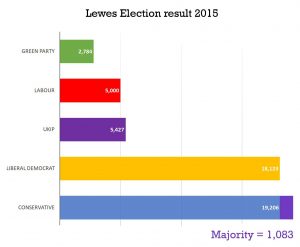
My home town of Lewes is a good example of the potential of a progressive alliance. Here, the Tories only have a tiny majority of 1,083 – so every vote counts!

Here’s how the parties line up in Lewes:

If you’re someone who voted Conservative last time but are worried about the direction this country or the world is going in, or someone who might normally vote Labour or Green (like me), take the step in this General Election of voting for the progressive party with the best chance of beating the Conservatives in your constituency.

This means in Lewes, I’ll be voting for the Liberal Democrats – for the first time ever.

I’ll be doing so in the knowledge that people in other constituencies are voting for my favoured party in the same way when it has the best chance of beating the Tories.

It’s a simple and powerful way to make the world better. So, at this General Election, please vote smart – and encourage everyone you know to do so as well.

Click here to find out which progressive party to vote for in your constituency.