How can we start humanising the world?

I’ve given quite a few talks and spoken with a lot of people since the publication of my book ‘Humanise: how knowing ourselves can change the world’ late in 2024. It’s been well received, and the audiences I’ve spoken to about it have found its vision of a humanised world very attractive. As result, the question that has most often come up has been ‘How can we take practical steps to move towards a more humanised world?’.

This is a question of particular relevance and urgency in the political and cultural times we live in globally, in which many aspects of the world appear to have quickly lurched in the opposite direction recommended by the book since its publication. These include the rise of populism, conflict, prejudice, environmental destruction and, overall, the dismantling of existing protective structures around human beings (such as the US pulling out of the Paris climate agreement) rather than the building of further structures to promote our flourishing.

I’ve therefore written the paper below to answer the increasingly urgent question of ‘What can each of us do to move from where the world is to a more humanised world?’. It contains 6 practical steps we can all take to start the shift towards a more humanised world – and at the moment, there doesn’t appear to be a more important issue than this.

Click here to read the paper (pdf).


Please also share the paper with your friends, colleagues and networks!

‘Humanise’ – new book out 25th October 2024

I’m very excited to announce that my fourth book ‘Humanise: How knowing ourselves could change the world’ will be out on Friday 25th October 2024.

A summary of the book is here, but the core aim of the book has been to provide an accessible yet reasonably accurate picture of how human beings think and behave, and then apply this to some of our most pressing challenges as creatures. It is based on the idea that there is little chance of us building a better society or addressing our challenges as a species if we don’t understand ourselves as creatures first.

Yet, as the book reveals, this is exactly what we have been trying to do over recent decades. Most people – including policy makers and politicians – have an inaccurate or incomplete conception of how human beings think and behave, based on out-of-date thinking from the Enlightenment, and this has hampered our ability to tackle major human challenges including the obesity crisis, disinformation, prejudice, violence and climate change.

The third part of the book seeks to bring all these themes together and ask why we seem to be struggling as creatures with aspects of the modern world, including the challenges mentioned above. It argues that the modern world we have built around us actually represents a hostile environment for human beings in a number of ways, and argues that the only way to build a world in which humans can flourish is to ‘humanise’ the ideas, institutions and structures that surround us. These radical changes will help support rather than exploit some of our cognitive and behavioural vulnerabilities – from our inbuilt thinking biases to our tendency for tribalism – and help nurture some of our traits that will be more useful in our interdependent modern world, including our ‘superpower’ of co-operation.

It is a hopeful but radical book that will challenge people’s views of what they are, as well as some of our most basic ideas, institutions and assumptions – from freedom to education. I feel it provides some basic foundations that could give us the most realistic chance of building a better and more sustainable future for our species and the planet.

The book has been a huge undertaking as it is essentially 3 books in one, with each requiring a strong review of the evidence base. The first part is a psychology book, the second an analysis of 5 key human challenges and the third part a discussion of political, social and practical possibilities for the world we could build ourselves in the future. Overall, I hope it is a book that will be both interesting and stimulate future research and action on how to build a better future based on understanding the creatures we really are.

Click here to pre-order it!

Talks

I’m doing an online talk to promote the book on the 28th October 2024. It would be lovely to see you there. The link to book (free) tickets is below:

100 places that changed the world

Here’s a new idea rather than a new, fully formed initiative – putting it out there to see if people would find it interesting.

There are hundreds of places and sites around the world that have an amazing story to tell – from the Trinity site in the Nevada desert where the first atomic bomb was exploded in 1945 to the Chicxulub crater   underneath the Yucatán Peninsula in Mexico that is believed to be the impact site of the asteroid that caused the extinction of the dinosaurs.

I think telling the stories of what happened at these places is a fascinating and different way of exploring events and ideas in history, and would make a great book, blog and/or podcast series. Before I go to the work of starting to put something together it would be great to hear if it was of interest to people – please drop me a line on the contact email address on this site to let me know!

Thanks and all the best, Richard

Podcast ep #9 – How to make a happier world – with Richard Layard

I’m very excited about the new episode of my podcast that’s out today. In it I talk to Lord Richard Layard, Emeritus Professor of Economics at the LSE. Richard is an economist who spent much of his life working on how to reduce unemployment and inequality. In more recent years though he has become one of the world’s leading figures exploring the science of happiness, as well as how better mental health could improve our social and economic life.

He is the author of a number of books, including ‘Happiness – lessons from a new science’, ‘Thrive – the power of psychological therapy‘ and his new book ‘Can we be happier?’, which is out now. He is also the founder of Action for Happiness – a not for profit organisation that is inspiring millions of people around the world to live happier lives.

In the first of 2 episodes I’ve recorded with Richard, I talk to him about his work on the subject of happiness and mental health, and how it has become one of the most pressing social issues of the modern world, with an ever-increasing base of scientific evidence behind it. We explore what is being done, and what more can be done, to build happiness more into our lives, politics and economies.

In the second episode – out on 11th May 2020 – I talk to him about what led him to set up Action for Happiness, and about the important work the organisation is doing.

These are really fascinating discussions on a topic I’ve also been involved with for over a decade with the not-for-profit organisation I founded, Life Squared.

Listen to our conversation here. Please subscribe to the podcast on Spotify or Apple Podcasts, check out the others in this series and share them with everyone you know!

New podcast – Making the world better

I’m very excited to announce that my new #podcast ‘Making the world better’ is now live!

In the podcast, I talk to people who are making the world better – not just those tackling big issues at a global scale but also those working at a local level or in less obvious areas too. I want to find out more about what these people do, the issues they’re working on and why they matter. In the end, I want to pay tribute to everyone who’s trying to make things better.

Each fortnightly episode has a different guest – and we’ve got some brilliant people lined up in the first few shows including CEOs of leading charities, political advisors, academics, fundraisers – and people who are working to help others in their local communities.

The podcast is available from all the usual providers, including Spotify, Apple Podcasts (coming soon) and Google Podcast (coming soon), as well as hosted here on https://richarddocwra.com/making-the-world-better/.

Please check out the podcast! I’d really appreciate it if you could share it with as many people as you can, and of course follow it on Spotify if you like it. And if you can take one further amazing step, leaving a review on Apple Podcasts (when it’s live there) would be extra helpful and much appreciated.

Beyond words

I’ve recently become tired of hearing people’s words – both those of others and my own. This evening I went for a walk on the hills of the South Downs as the sun set, and it reminded me of the joy of being without words.

Just standing silently and letting the sights and sounds of nature wash over me gave me the most profound feeling of peace and belonging.

As I stood there listening, breathing and looking, I realised that no words could convey the richness and complexity of the experience of just being in that natural landscape. You can only understand it if you experience it yourself.

And I realised that this act of ‘experiencing nature’ – just appreciating the experience of existing within it – is one of the great joys of my life.

The event that changed my world

I’ve been thinking recently about my emotional reaction to a particular event in human history. I’ve felt it chipping away at me in recent years as I’ve continued to research it, and realised recently that it has had a profound effect on the way I see the world. I’d like to share it here – not, I hope, out of self-indulgence, but to show where it has led me.

Throughout history there have been countless examples of human beings being cruel or unkind to each other. Some have been at a small scale, such as the minor, everyday ways that people can overlook each other’s needs, and others have been at an industrial scale of pre-planned cruelty.

The event that affected me for life and changed my thinking was The Holocaust.

This event has broken my heart about human beings. It shows that the worst things you can ever imagine (or, worse than you can ever imagine) do happen and have happened. The emotional hammer blow is not just the fear that it’s within the capacity of human beings for it to happen again, but also the fact that it happened at all.

The possibility that human beings could do this to each other – in broad daylight, in a planned, sustained way and in front of each other – just shattered my trust in human beings and society. It’s changed my view of the world, life and human beings.

All the stuff above is simply my emotional reaction of course, and in itself may not seem particularly useful.

I’m well aware in theoretical terms about the factors that led to The Holocaust and other human tragedies – including how we think and behave as human beings, how circumstances and power can influence behaviour and how societies can change. But an emotional reaction can be a useful spark to set someone into action or down a different path in life, and I think it’s done that for me.

My emotional reaction to The Holocaust doesn’t reduce my love and concern for human beings, or my desire to help and look after other people. In fact, it strengthens my resolve to protect people and ensure things like this do not happen again. I feel as if my life should be devoted to this, in whatever ways I can achieve it.

The Holocaust Survivor Elie Wiesel put it far better than I ever could in his Nobel Peace Prize acceptance speech in 1986, explaining how after his experience:

“…I swore never to be silent whenever and wherever human being endure suffering and humiliation. We must take sides. Neutrality helps the oppressor, never the victim. Silence encourages the tormentor, never the tormented. Sometimes we must interfere. When human lives are endangered and when human dignity is in jeopardy, national borders and sensitivities become irrelevant. Wherever men and women are persecuted because of their race, religion, or political views, that place must – at that moment – become the centre of the universe.”

My initial effort at taking some action on this was in the Life Squared publication ‘How to be civilised’ – available to download here for free. But I must – and we all must – do so much more, not just as projects we work on, but as a commitment on how to live our daily lives. I am determined that there will be more work and action from me on this in the years ahead.
How to stop the rise of manipulation

Communication is power.

In the modern world, one of the most effective tools used by the powerful to build and exercise their power is communication. More specifically, it’s the ability to understand how human beings think and behave and then use this knowledge to influence people – both individually and in massive numbers.

This power is exercised through a wide range of channels – from advertising to social media – and surrounds each of us on a daily basis. It can be harnessed by anyone with the desire and necessary resources to influence other people – from politicians to companies to campaigning groups – regardless of whether their intentions are good or bad.

There are now plenty of agencies and consultancies helping the powerful to influence (or manipulate) people as effectively as possible  – and yet there is no-one helping to protect the public from the exploitation at the hands of this influential power.

In an information age, where the world has become more complex and information and communication have become weapons that can be used against people, the time has come for an organisation to help the public navigate this complexity and defend themselves against these weapons.

My not-for-profit organisation, Life Squared, has been helping people think about this issue for several years – through publications like ‘The problem with consumerism‘ and our forthcoming book ‘The Life Trap – and how to escape it’ – but we need more support to raise awareness of it. This is a critical issue affecting a range of areas of modern society, including mental health, climate change and the rising influence of populism, and politicians and policy makers need to take notice of it – for the sake of our own lives, as well as a better society.

The Life Trap – coming soon

I’ve just completed a booklet for Life Squared that has turned into a book!  It’s a piece of work that I’ve been putting off for years as I knew it would be large and complex, but I’m delighted to have finished it as I think it’s a critical issue, yet one that hasn’t been exposed in any significant way to date.

It’s called ‘The Life Trap – and how to escape it’. Or – ‘how to think for yourself’. Here’s a brief summary.

You may not know it, but you’re probably caught in the Life Trap.

You live in a complex world where you are bombarded daily with a wide range of powerful messages and influences, but at no point in your life have you been given the skills or tools you need to manage this assault on your mind.

As a result, you have ended up caught in a trap, like most of us in the modern world – with worldviews, values and lives that are stifled and restricted, only following the path that we’ve been led down by the dominant ideas of the people and society we’ve grown up in. As a consequence, you pursue career achievement and material success, worry about what other people think of you and lead a busy, distracted life. Your life feels meaningless and isolated yet you find it hard to stop, take control and change it.

This book explores what causes the Life Trap and why it matters so much – not just for our own lives but for society as a whole.

You will find out how to escape the Life Trap – as well as how we can change our education system, politics and other areas of society to give everyone the best chance of independent, fulfilled lives, and build a peaceful and civilised society.

The book will be free to download from the Life Squared website in the next few weeks. More news as soon as it’s published!


Be a light in the darkness in 2018

We live in difficult political times. Rarely does a week pass without Donald Trump’s administration ignorantly destroying yet another important piece of hope for the world – whether in foriegn policy or its attitude towards climate change.

Under such circumstances, it’s easy to feel a sense of complete despair and powerlessness. With this powerless can come a loss of motivation. What’s the point in trying to live a good life or make a better world when your own small but committed efforts are dwarfed by the ignorance and destruction being meted out by some of those people in power?

The answer is this. The way we choose to live our own lives is now more important than ever. If we are living at a time where we can’t rely on those in power to speak and work for us, then we need to taking control in the one area where we do have choice and power – in our own lives.

We shouldn’t be lowering our own standards in the face of these problems. We should be setting an example of how to live kind, compassionate, thoughtful lives. We need to be beacons for the rest of society in dark times – millions of little points of light illuminating the way for other people.

So, here is a thought for the Christmas period and a resolution for the new year.

Avoid the news if you want. Don’t read or watch it if it’s just depressing and paralysing you. Instead, focus on living a good life in your own small way, with the people and communities around you. You’ll be leading a good, fulfilling life. You’ll also be setting an example and providing a light.

And one day, perhaps the world will catch up with you again.


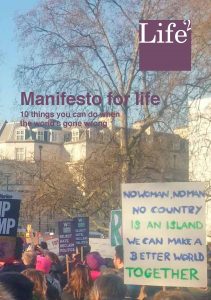
For more on this, read: Manifesto for Life – 10 things you can do when the world’s gone wrong – from Life Squared